
STOP-BANG Questionnaire: How to Score It and What the Score Means
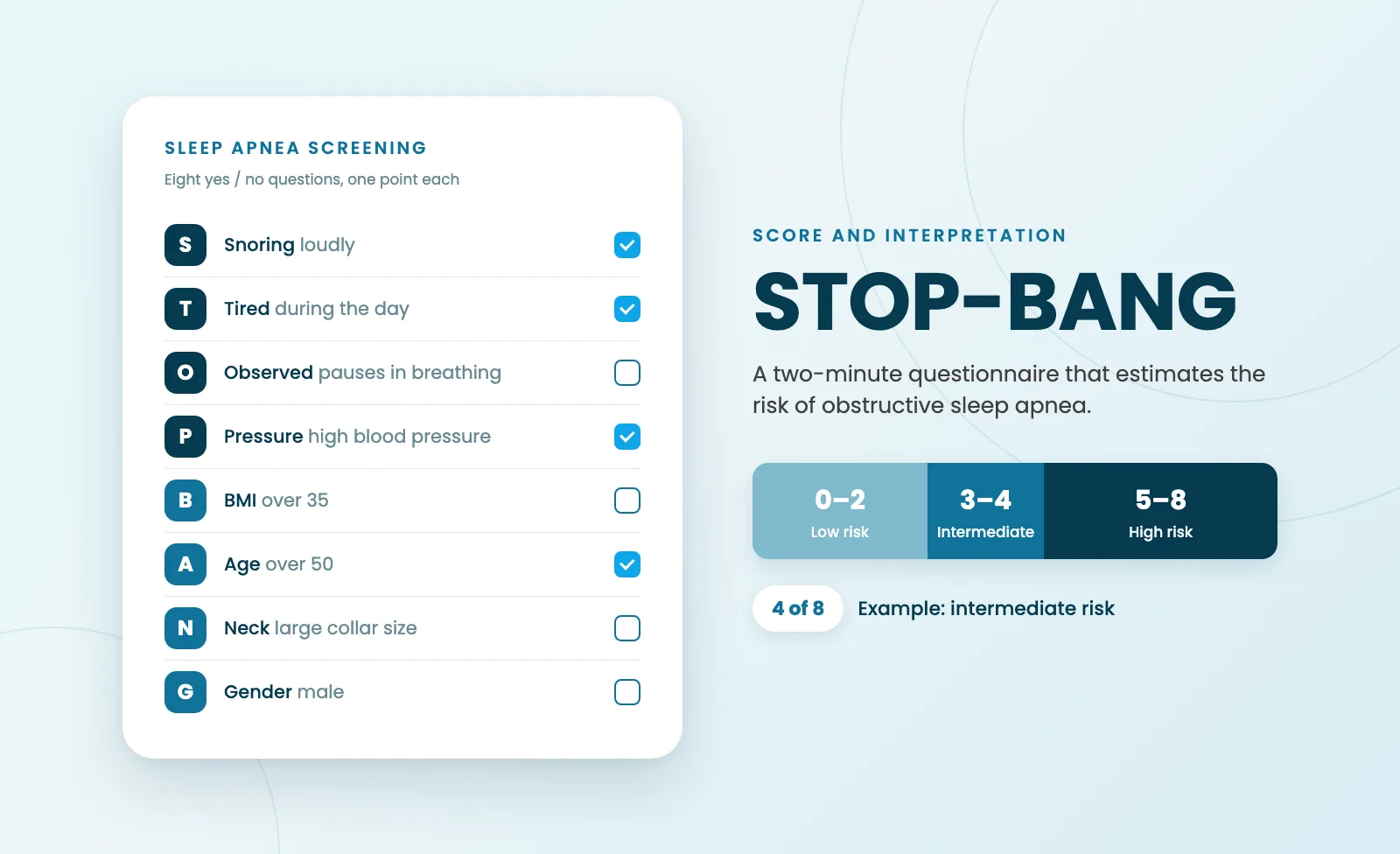
The STOP-BANG questionnaire is an eight-question screening tool that estimates the risk of obstructive sleep apnea. Each yes answer scores one point, for a total between 0 and 8. A score of 0 to 2 is low risk, 3 to 4 is intermediate risk, and 5 to 8 is high risk for moderate to severe sleep apnea. It is very good at flagging people who need a sleep study, but it cannot diagnose sleep apnea on its own.
This guide covers the eight questions and how to score them, the rule that moves a score of 3 or 4 into the high-risk group, what the research says about accuracy, where the questionnaire tends to miss people, and how a dental sleep practice can use it alongside the Epworth Sleepiness Scale and the Mallampati score.
What Is the STOP-BANG Questionnaire?
The questionnaire was developed by Dr. Frances Chung and colleagues at the University Health Network in Toronto and published in Anesthesiology in 2008. It was designed for surgical patients, where undiagnosed sleep apnea raises the risk of breathing problems during and after anesthesia, so it had to be quick, need no equipment beyond a tape measure and scale, and be easy for any clinician to score. It has since been validated in sleep clinics, primary care, and the general population, and it is now one of the most widely used sleep apnea screening tools in both medical and dental settings. The developers write it as STOP-Bang; STOP-BANG is the common spelling.
Your oral health is more important than you might realize. It's not just about having a bright smile, it's about maintaining your overall well-being. Regular dental check-ups, proper brushing and flossing, and a healthy diet can prevent many dental issues.
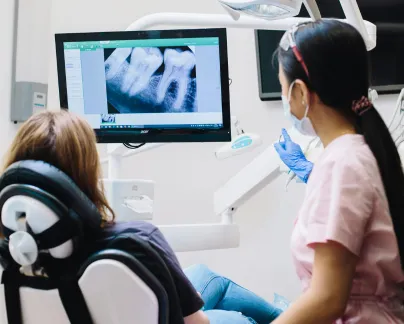
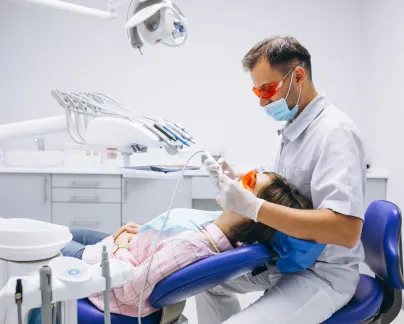
The name is a mnemonic. The first four letters, STOP, are questions the patient answers about symptoms and history. The last four, BANG, are facts about the patient that the clinical team can usually record or measure.
The four STOP questions
- S for Snoring. Do you snore loudly, louder than talking or loud enough to be heard through a closed door?
- T for Tired. Do you often feel tired, fatigued, or sleepy during the day, for example falling asleep while driving or while talking to someone?
- O for Observed. Has anyone observed you stop breathing, or choking or gasping, during your sleep?
- P for Pressure. Do you have high blood pressure, or are you being treated for it?
The four BANG measurements
- B for BMI. Is the body mass index more than 35 kg/m²?
- A for Age. Is the person older than 50?
- N for Neck. Is the neck circumference large? The current version counts 17 inches (43 cm) or more in men and 16 inches (41 cm) or more in women, measured around the Adam's apple. Older versions used a single cutoff of 40 cm for everyone, so check which version a form is using.
- G for Gender. Is the person male?
Snoring and observed pauses usually depend on a bed partner. Someone who sleeps alone may answer no simply because nobody has told them, which is one reason a low score should never end the conversation if other signs are present.
How Do You Score the STOP-BANG Questionnaire?
Every yes answer is worth one point and every no answer is worth zero, giving a total from 0 to 8. The standard interpretation is:
- 0 to 2. Low risk of moderate to severe obstructive sleep apnea.
- 3 to 4. Intermediate risk.
- 5 to 8. High risk.
The middle band has one extra step. A score of 3 or 4 is reclassified as high risk when at least two of the four STOP answers are yes and the person also meets one of these criteria:
- Male gender.
- BMI over 35 kg/m².
- Large neck size, as defined above.
This rule matters because two people with the same total can carry very different risk. Two STOP symptoms plus a large neck point toward an anatomically narrow airway that is already causing problems. Older age plus high blood pressure plus male gender, with no symptoms at all, describes a large share of the adult population.
Three worked examples
- A 58-year-old woman who snores loudly and takes medication for high blood pressure. Her BMI is 31 and her collar size is 15 inches. She scores Snoring, Pressure, and Age, for a total of 3. She has two STOP answers but none of the extra criteria, so she stays at intermediate risk.
- A 46-year-old man whose wife has seen him stop breathing at night and who snores. His BMI is 29 and his collar size is 17.5 inches. He scores Snoring, Observed, Neck, and Gender, for a total of 4. He has two STOP answers and is male, so he is classified as high risk despite being under 50 and not obese.
- A 34-year-old woman who feels tired most afternoons and has no other positive answers. She scores Tired only, for a total of 1, which is low risk. If her partner later reports snoring and pauses, or the dental exam shows a crowded airway, the score should be repeated rather than treated as settled.
How Accurate Is the STOP-BANG Score?
STOP-BANG was built to miss as few people with significant sleep apnea as possible, and it does that well. The trade-off is that it flags many people who turn out not to have it.
In the original study, the four STOP questions alone detected 66 to 80 percent of patients with sleep apnea, depending on severity. Adding the four BANG items and using a cutoff of 3 or more raised sensitivity to about 84 percent for any sleep apnea, 93 percent for moderate to severe sleep apnea, and 100 percent for severe sleep apnea. Specificity fell as severity rose, to between roughly 37 and 56 percent. In plain terms, a positive screen is a reason to investigate, not a sign that the person has the disease.
A 2015 meta-analysis of 17 studies and more than 9,200 patients confirmed the pattern. Among patients seen in sleep clinics, a score of 3 or more detected 90 percent of any sleep apnea, 94 percent of moderate to severe disease, and 96 percent of severe disease. The same analysis showed how the likelihood of severe sleep apnea climbs with each additional point:
Probability of severe obstructive sleep apnea by STOP-BANG score (sleep clinic patients)
| STOP-BANG score | Probability of severe OSA (AHI 30 or more) |
|---|---|
| 3 | About 25% |
| 4 | About 35% |
| 5 | About 45% |
| 6 | About 55% |
| 7 or 8 | About 75% |
Source: Nagappa and colleagues, PLoS One, 2015. Probabilities apply to patients already referred to a sleep clinic, where sleep apnea is common. In a general dental population the same score carries a lower probability.
Two practical conclusions follow. A low score is most reassuring for severe disease and least reassuring for mild disease. In the sleep clinic data, a negative screen ruled out severe sleep apnea about 90 percent of the time but ruled out any sleep apnea only about 46 percent of the time. And a high score is a strong signal: at 5 or more, the chance of moderate to severe sleep apnea is high enough that testing should not be delayed.
Where Does STOP-BANG Fall Short?
The questionnaire is reliable for what it was designed to do, but some groups are scored unfairly by it.
- Women. The male gender item and the larger male neck threshold give men two extra chances to score. Women with sleep apnea also more often report fatigue, insomnia, morning headache, or low mood than loud snoring and sleepiness. As a result, women tend to score lower at the same severity of disease.
- People of Asian descent. Craniofacial structure means sleep apnea often develops at a lower body weight, so the BMI over 35 item rarely applies. Researchers have tested modified STOP-BANG versions with lower BMI cutoffs, usually somewhere between 25 and 30. These pick up more cases at the cost of more false positives, and no single modified cutoff has been adopted everywhere.
- People without a bed partner. Snoring and observed apneas are frequently answered no for lack of a witness.
- Children. The questionnaire was not designed or validated for children, who need a different screening approach. Our pediatric airway screening protocol covers what to ask at the hygiene recall instead.
- Central sleep apnea. STOP-BANG screens for obstructive sleep apnea only. It does not detect central sleep apnea, which has different causes and treatment.
Above all, a questionnaire cannot replace a sleep test. The American Academy of Sleep Medicine's 2017 diagnostic guideline makes a strong recommendation that clinical tools, questionnaires, and prediction algorithms should not be used to diagnose obstructive sleep apnea in adults without polysomnography or home sleep apnea testing.
How Does STOP-BANG Compare With the Epworth Scale and Mallampati Score?
These three tools are often confused, but they measure different things. Used together, they give a much fuller picture than any one alone.
STOP-BANG, Epworth Sleepiness Scale and Mallampati score at a glance
| STOP-BANG | Epworth Sleepiness Scale | Mallampati score | |
|---|---|---|---|
| What it measures | Risk of obstructive sleep apnea | Daytime sleepiness | Visibility of the oropharyngeal airway |
| Who completes it | Patient answers 4 questions; team records 4 facts | Patient | Clinician, chairside |
| Scoring | 0 to 8; 3 or more is commonly used to refer | 0 to 24; 11 or more is excessive sleepiness | Class I to IV |
| Time needed | About 2 minutes | About 2 minutes | Under a minute |
| Main limitation | Many false positives; scores women lower | Many people with sleep apnea score normal | Moderate predictor on its own |
STOP-BANG asks whether this person is likely to have sleep apnea. The Epworth scale asks how much it is affecting them during the day. The Mallampati score, along with other exam findings such as a scalloped tongue, tooth wear from grinding, or enlarged tonsils, shows whether the anatomy fits. When all three point the same way, a referral is easy to justify and easy for the patient to accept.
How Should a Dental Practice Use STOP-BANG?
Dentists often see adults more regularly than physicians do, and the American Dental Association's 2017 policy encourages dentists to assess sleep-related breathing disorder risk as part of the medical and dental history and to refer patients to physicians for diagnosis. STOP-BANG is the most practical way to make that assessment routine. The full screening workflow is covered in our guide on how to screen dental patients for obstructive sleep apnea. These are the points specific to STOP-BANG.
- Put it in the intake. The four STOP questions belong in new patient paperwork and the annual health history update. Our guide to what a dental sleep medicine intake form should include shows where it fits.
- Measure rather than ask. Patients guess their collar size and weight poorly. Measuring the neck with a tape at the level of the Adam's apple and calculating BMI from measured height and weight makes the BANG half far more reliable. Many practices already take blood pressure chairside, which can catch hypertension the patient did not know about.
- Set a referral trigger and write it down. A common protocol is to refer at a score of 3 or more, or at any high-risk combination, and to refer sooner when the Epworth score is 16 or more or the patient reports drowsy driving. A written trigger means every team member makes the same call.
- Refer for testing, not for a label. A dentist cannot diagnose sleep apnea. The referral goes to the patient's physician or a sleep physician for a home sleep apnea test or in-lab study, and treatment begins only after that diagnosis. Our article on whether a dentist can treat sleep apnea without a sleep study explains why that order matters for both care and coverage.
- Use it before sedation. Because STOP-BANG was built for pre-anesthesia assessment, practices that offer oral or IV sedation commonly include it in the pre-sedation airway review, alongside their own sedation protocols and state requirements.
- Re-screen when things change. Weight gain, a new hypertension diagnosis, menopause, or a partner newly reporting snoring can all move a score from low to intermediate.
Record the date, every individual answer, and the measured values, not just the total. Individual answers show why a patient scored as they did, and they give the sleep physician useful context. When the questionnaire is captured through digital patient onboarding and stored in the same record as the sleep study and referral letters, as it is in Appnea, the dentist and the co-managing sleep physician are working from the same information.
One administrative note. The STOP-Bang questionnaire is owned by the University Health Network and Dr. Chung, and its developers ask that clinical and commercial use be licensed through stopbang.ca. Practices and software vendors should confirm the current terms before printing it on forms or building it into systems.
What Should You Do With Your STOP-BANG Score?
If you have scored yourself, the number is a prompt for a conversation, not a diagnosis.
- A score of 5 or more, or a high-risk combination, is a good reason to book an appointment with your physician soon and mention snoring, tiredness, and any pauses a partner has noticed.
- A score of 3 or 4 is worth raising at your next medical or dental visit, especially if you have high blood pressure, morning headaches, or trouble staying awake.
- A score of 0 to 2 is reassuring but not conclusive. If you have strong symptoms anyway, say so.
Diagnosis usually means a home sleep apnea test or an overnight study, and our guide to reading sleep study results explains what the numbers on the report mean. If sleep apnea is confirmed, there is more than one way to treat it. CPAP, custom oral appliances made by a dentist, and other options each suit different patients, as our comparison of CPAP and oral appliance therapy explains.
Key Takeaways
- STOP-BANG has eight yes or no items, one point each, for a total of 0 to 8.
- 0 to 2 is low risk, 3 to 4 intermediate, and 5 to 8 high risk for moderate to severe obstructive sleep apnea.
- A score of 3 or 4 becomes high risk with two or more STOP answers plus male gender, BMI over 35, or a large neck.
- The questionnaire is highly sensitive but not very specific, so it is best at deciding who needs a sleep test.
- It tends to under-score women, people of Asian descent, and people without a bed partner.
- It screens and does not diagnose. Diagnosis requires a sleep study interpreted by a physician.
Frequently Asked Questions
What is a normal STOP-BANG score?
A score of 0 to 2 is considered low risk for moderate to severe obstructive sleep apnea. It is not a guarantee of normal breathing during sleep, particularly in women and in people with milder disease.
Is a STOP-BANG score of 3 bad?
A score of 3 places a person in the intermediate-risk band. Many dental and medical practices use 3 or more as the point at which they recommend a conversation with a physician about testing, because few people with moderate to severe sleep apnea score below 3.
What does a STOP-BANG score of 4 mean?
A score of 4 is intermediate risk. It is reclassified as high risk when at least two of the four STOP answers are yes and the person is also male, has a BMI over 35, or has a large neck size.
What neck size counts on the STOP-BANG questionnaire?
The current version counts a neck circumference, measured around the Adam's apple, of 17 inches (43 cm) or more in men and 16 inches (41 cm) or more in women. Older versions used a single cutoff of 40 cm for everyone.
Can the STOP-BANG questionnaire diagnose sleep apnea?
No. It estimates risk. Obstructive sleep apnea is diagnosed by a physician using an in-lab sleep study or a home sleep apnea test.
Is there an official STOP-BANG calculator or PDF?
The official questionnaire and scoring information are published by its developers at stopbang.ca. Scoring itself is simple: count the yes answers, then apply the high-risk rule for scores of 3 or 4.
Can STOP-BANG be used for children?
No. It was developed and validated in adults. Children are screened with different questions about snoring, breathing, behavior, and growth, and are scored on stricter sleep study criteria.
How often should a dental practice repeat the questionnaire?
At the new patient visit, at least annually at recall, and whenever something relevant changes, such as weight gain, a new high blood pressure diagnosis, new snoring reported by a partner, or an upcoming sedation appointment.
Final Thoughts
STOP-BANG has lasted because it asks the right eight questions in under two minutes and rarely lets a person with severe sleep apnea through unnoticed. Its weakness is the other side of that strength: many positives turn out to be negative, and some groups score lower than their risk deserves. Measured properly, combined with an airway exam and a sleepiness score, and tied to a clear referral pathway, it is one of the most useful two-minute tasks a dental team can add to a visit. This article is general education and not medical advice.
References
- Chung F, Yegneswaran B, Liao P, et al. STOP questionnaire: a tool to screen patients for obstructive sleep apnea. Anesthesiology. 2008;108(5):812-821. PubMed
- Chung F, Abdullah HR, Liao P. STOP-Bang questionnaire: a practical approach to screen for obstructive sleep apnea. Chest. 2016;149(3):631-638. PubMed
- Nagappa M, Liao P, Wong J, et al. Validation of the STOP-Bang questionnaire as a screening tool for obstructive sleep apnea among different populations: a systematic review and meta-analysis. PLoS One. 2015;10(12):e0143697. PubMed
- Kapur VK, Auckley DH, Chowdhuri S, et al. Clinical practice guideline for diagnostic testing for adult obstructive sleep apnea: an American Academy of Sleep Medicine clinical practice guideline. Journal of Clinical Sleep Medicine. 2017;13(3):479-504. Full text
- American Dental Association. The role of dentistry in the treatment of sleep related breathing disorders. Policy adopted by the ADA House of Delegates, 2017.
- STOP-Bang questionnaire, official website, University Health Network. stopbang.ca

Need help ?
Schedule your initial consultation today and start your journey towards a pain-free, healthier smile. Contact us now!
Blog Suggestions

Epworth Sleepiness Scale: How to Score It and What the Number Means
The eight Epworth questions, the 0 to 24 scoring bands, what a score of 11 or more means, what the scale cannot tell you about sleep apnea, and how to use it to document and track oral appliance therapy.

Mallampati Score and Sleep Apnea: What Classes I to IV Mean
What each Mallampati class shows, how to perform the assessment correctly, how strongly the score predicts obstructive sleep apnea, how it differs from Friedman tongue position, and where it fits in dental screening.
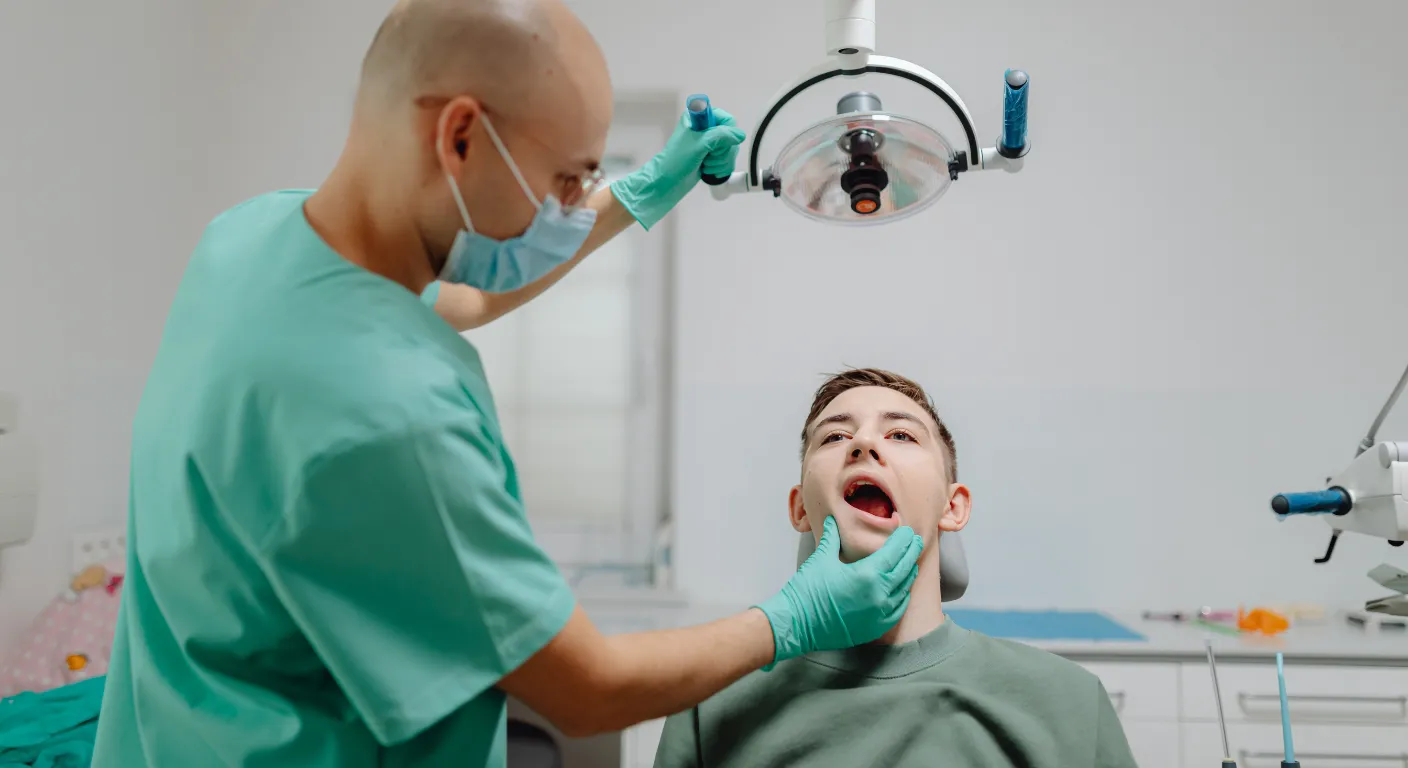
How do you screen dental patients for obstructive sleep apnea?
Screening dental patients for obstructive sleep apnea combines a validated questionnaire, a focused airway examination, and a clear referral trigger.
How to Read Sleep Study Results: AHI, RDI, and ODI Explained
What AHI, RDI, REI, and ODI mean on a sleep study report, the severity thresholds for adults, why the 3 percent and 4 percent hypopnea rules give different scores, and how the numbers decide oral appliance coverage.