
Medical Billing Is Not Dental Billing
Medical billing is not dental billing with different forms. It is a different coding system, a different claim form, a different adjudication logic, a different appeals process, and a different definition of what "approved" means. This is why the standard approach — cross-training one existing front-desk person to "handle the sleep cases too" — usually fails, and why it fails in a predictable way. The alternative is not necessarily hiring a full-time medical biller. It is dividing the labour along the seam where the two systems actually differ.
The Structural Differences That Break Cross-Training
Dental billing and medical billing look superficially similar and diverge almost immediately.
- Code systems. Dental uses CDT procedure codes on an ADA claim form. Medical uses ICD-10 diagnosis codes paired with HCPCS or CPT procedure codes on a CMS-1500. In dental, the procedure largely stands alone. In medical, the diagnosis code must justify the procedure code, and a mismatch is an automatic denial regardless of clinical appropriateness.
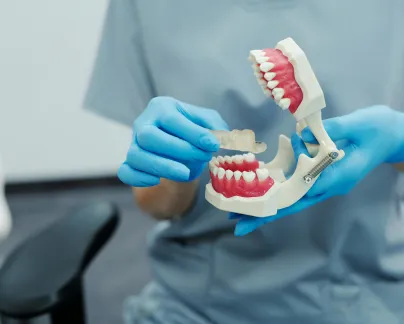
Your oral health is more important than you might realize. It's not just about having a bright smile, it's about maintaining your overall well-being. Regular dental check-ups, proper brushing and flossing, and a healthy diet can prevent many dental issues.

- Medical necessity. Dental claims are adjudicated largely on whether the procedure was performed and covered. Medical claims are adjudicated on whether the procedure was necessary, which means narrative documentation, a physician order, and supporting clinical evidence are part of the claim rather than backup.
- Prior authorization. Dental predetermination is advisory and often optional. Medical prior authorization is frequently mandatory and binding, with a hard sequencing requirement: obtain it before the service or forfeit payment.
- Supplier and provider enrollment. Billing E0486 to Medicare requires DMEPOS supplier accreditation, a surety bond, and adherence to supplier standards. Nothing in dental billing has an analogue to this.
- Appeals. Dental appeals are typically a letter and a resubmission. Medical appeals run through defined levels — redetermination, reconsideration, administrative law judge — each with its own deadline and evidentiary standard. Missing a window ends the claim permanently.
- Timelines. Dental claims often adjudicate in two weeks. Medical DME claims involving prior authorization and documentation review routinely run 30 to 90 days, which changes cash flow planning entirely.
Why Cross-Training One Person Usually Fails
The failure is rarely about intelligence or effort. It is about three structural mismatches.
First, interrupt-driven work cannot coexist with deadline-driven work. A front-desk role is defined by interruption: phones, check-ins, scheduling, payment collection. Medical billing is defined by sequenced tasks with unforgiving deadlines — authorization before fabrication, appeal within the window, documentation assembled before submission. When both live in one person, the interrupt-driven work always wins, because it is visible and immediate. The medical case slips quietly.
Second, volume is too low to build fluency and too high to ignore. A practice delivering four to eight sleep cases a month generates enough medical claims to matter financially but not enough repetition for someone to become genuinely fluent in payer-specific rules. The cross-trained person re-learns the process every time, which is slow and error-prone.
Third, the knowledge is perishable and undocumented. Payer policies change, LCDs get revised, portal workflows shift. A single cross-trained person accumulates this knowledge in their head. When they leave — and front-desk turnover is high — the practice loses the entire medical billing capability at once and often does not discover the gap until claims start ageing.
The Division of Labour That Works
Split the work by the nature of the task rather than by the case. Three functions, which can map to fewer than three people.
- Clinical documentation, owned by the clinical team. The dentist and assistant own the records that create medical necessity: the screening result, the intraoral scan or impression record, the device model and FDA clearance status, the fitting and titration notes, and the proof of delivery. This work happens at the chair and cannot be outsourced. The key discipline is documenting to a medical standard at the time of service, not reconstructing it later.
- Financial clearance, owned by a dedicated coordinator. Verification of benefits, prior authorization, patient financial conversation, and collection at delivery. This role is patient-facing and benefits from continuity, but it is scheduled work rather than interrupt work. In a practice with moderate sleep volume, this is often a part-time role or a defined block in one person's week — protected time with the phones covered by someone else.
- Claim submission and appeals, owned by a specialist. This is the function most practices should outsource, at least initially. A billing service or contract medical biller handling volume across many practices maintains the payer-specific fluency that a single in-house person cannot build at four to eight cases a month. Typical pricing runs a percentage of collections; evaluate it against the realistic cost of denied and aged claims rather than against zero.
The seam matters more than the boxes. The handoff points — clinical to coordinator at the scan, coordinator to biller at authorization, biller back to coordinator at adjudication — should each have a defined artifact that moves. When handoffs are conversational rather than documented, cases fall through regardless of how the roles are drawn.
When to Bring Billing In-House
Outsourcing is the right default until volume justifies the fixed cost of expertise. A rough threshold: sustained volume above roughly 15 to 20 delivered cases per month, or a payer mix concentrated enough that one person can master a small number of plans. Below that, the percentage paid to a service is almost always cheaper than the denials, write-offs, and missed appeal windows an under-practised in-house biller produces. Above it, an in-house specialist who also owns verification and authorization becomes the more economical structure and gives the practice faster feedback loops.
Making the Transition Survivable
Whichever structure is chosen, document the payer knowledge outside anyone's head. A simple internal reference — one page per major payer covering prior authorization requirements, CPAP failure documentation standards, frequency limits, portal access, and known denial patterns — converts perishable individual knowledge into a practice asset. Practices that maintain this survive staff turnover. Practices that do not rebuild the capability from scratch every eighteen months.
Key Takeaways
- Medical and dental billing differ in code systems, medical necessity standards, authorization rules, enrollment requirements, appeals, and timelines.
- Cross-training fails because interrupt-driven work displaces deadline-driven work, volume is too low to build fluency, and knowledge stays undocumented.
- Split by task type: clinical documentation in-house, financial clearance in a protected role, claims and appeals often outsourced.
- Outsource below roughly 15 to 20 delivered cases per month; consider in-house above it.
- Maintain a written payer reference so capability survives turnover.
Frequently Asked Questions
Q: Can our dental biller learn medical billing?
A: Some can, given protected time, formal training, and enough volume to build fluency. The failure mode is asking them to do it alongside a full front-desk workload.
Q: What does outsourced medical billing typically cost?
A: Commonly a percentage of collections. Compare it against current denial and write-off rates rather than against doing it for free, which is not the actual alternative.
Q: Do we still need someone in-house if we outsource?
A: Yes. Verification of benefits, prior authorization, and the patient financial conversation are patient-facing and belong in the practice.
Q: What is the single highest-leverage role to add first?
A: The financial clearance coordinator. Most revenue loss in dental sleep originates before the claim is ever submitted.
Q: How do we evaluate a billing service?
A: Ask for first-pass approval rate on E0486 specifically, average days to payment, and how appeals are handled and charged. Generic dental billing references are not predictive.
Final Thoughts
The practices that struggle with dental sleep medicine economics usually have competent clinicians and a broken administrative seam. Treating medical billing as an extension of dental billing is the most common version of that break. Drawing the division of labour along the real fault line — clinical documentation, financial clearance, claims expertise — costs less than most practices assume and resolves the majority of revenue cycle problems before they reach the claim.

Need help ?
Schedule your initial consultation today and start your journey towards a pain-free, healthier smile. Contact us now!
Blog Suggestions
Medical Credentialing for a Dental Sleep Practice
Realistic timelines, CAQH discipline, and the in-network versus cash-pay decision — including why the out-of-network model nets more per case for many practices.
GLP-1s After Zepbound: Referral Source, Not Competitor
The FDA approved tirzepatide for moderate-to-severe OSA in adults with obesity. Why residual disease, long treatment intervals, and discontinuation make this one of the strongest new referral sources in dental sleep medicine.
The First Joint AASM/AADSM Oral Appliance Guideline
Patient preference is now an explicit indication, not just CPAP intolerance. What to change in your consent form, titration protocol, and follow-up schedule.

When Payers Require an Appliance Trial Before Hypoglossal Nerve Stimulation
What counts as a documented appliance failure, how to run a time-bounded trial that satisfies authorisation review, and how to position the practice inside a surgical pathway.