
What follow-up schedule should you use for oral appliance therapy patients?

A defensible follow-up schedule for oral appliance therapy (OAT) follows the AADSM clinical practice cadence: a delivery check at one week, a titration visit at one month, an efficacy sleep test at three months, a stabilization visit at six months, and annual recalls thereafter. Each visit documents subjective symptoms, Epworth Sleepiness Scale (ESS) scores, device condition, and occlusal changes. This cadence supports HCPCS E0486 medical necessity, satisfies most commercial payers, and catches side effects before they become permanent. Telemedicine fills the gaps between in-person visits.
One-Week Delivery Check
The one-week visit confirms the device seats fully, retains overnight, and does not cause unmanageable soreness or hypersalivation. Review insertion and removal technique, verify the patient is wearing the device a minimum of 4 hours per night, and document any morning jaw discomfort, tooth tenderness, or temporomandibular symptoms. Most patients tolerate the device within 5 to 7 nights; persistent pain at one week warrants an early titration or device adjustment. Record the wear time, subjective snoring change reported by the bed partner, and any occlusal complaints in the chart.
One-Month Titration Visit
Your oral health is more important than you might realize. It's not just about having a bright smile, it's about maintaining your overall well-being. Regular dental check-ups, proper brushing and flossing, and a healthy diet can prevent many dental issues.

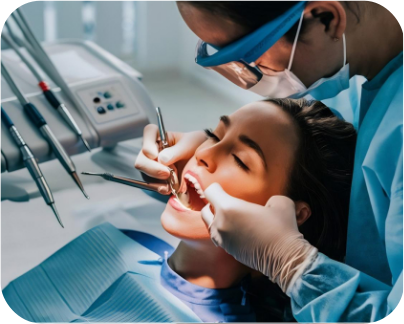
At one month the patient should be wearing the device nightly with manageable side effects. Begin protrusive titration in 0.25 to 0.5 mm increments depending on the device platform, targeting symptom resolution: elimination of witnessed apneas, reduction of snoring, and an ESS score below 10. Document the current protrusive position in millimeters, the patient's subjective improvement, and any new symptoms such as bite changes or tooth movement. Most patients reach therapeutic protrusion between 60 and 75 percent of maximum at this stage.
Three-Month Efficacy Test
The AADSM and AASM jointly recommend an objective efficacy test at the titrated position once symptoms have stabilized, typically at three months. A home sleep apnea test (HSAT, CPT 95806) worn with the device in place documents the residual AHI and oxygen desaturation. A successful outcome is generally defined as AHI below 5 with resolution of symptoms, or below 10 with significant symptom improvement in patients who cannot tolerate further advancement. The titrated HSAT report becomes the cornerstone of E0486 medical necessity documentation and any future Medicare audit defense.
Six-Month Stabilization Visit
The six-month visit assesses long-term tolerance, occlusal stability, and device wear. Examine for posterior open bite, anterior crossbite, mandibular advancement creep, and any temporomandibular joint symptoms. Inspect the device for cracks, hinge wear, screw stripping, and elastic fatigue. Reinforce the patient's morning AM aligner or jaw exercise protocol if one was prescribed. Re-administer the ESS and document any change in daytime sleepiness, witnessed apneas, or nocturia.
Annual Recall
Annual recalls combine a dental hygiene visit with an OAT review. Capture an updated ESS, inspect the device, take photos or scans of the occlusion for comparison with baseline, and confirm continued nightly use. Most appliances last 3 to 5 years depending on bruxism and material; an annual recall lets the clinician anticipate replacement and re-engage the sleep physician for a repeat HSAT if symptoms have returned. CMS expects an annual documented encounter for ongoing E0486 supply or replacement claims.
What To Assess At Every Visit
Every OAT follow-up should document four domains: subjective sleep symptoms (snoring, witnessed apneas, daytime sleepiness, morning headaches), ESS score, device condition (cracks, retention, hinge integrity), and occlusal changes (posterior open bite, mandibular shift, tooth mobility). A short bite-stick test and inter-incisal opening measurement take less than two minutes and catch developing TMJ strain early. Photograph or scan the occlusion annually to create an objective record.
Documentation Requirements
Defensible OAT documentation includes the original sleep study (PSG or HSAT with AHI and date), the prescribing sleep physician's order, the face-to-face encounter note required by CMS, the protrusive position at each visit in millimeters, ESS scores, subjective and objective symptom changes, and the titrated efficacy HSAT report. The AADSM provides a downloadable progress note template that captures every element a Medicare auditor or commercial payer would request.
Telemedicine For Interim Check-Ins
Telehealth visits using CPT 99421 to 99423 (online digital E/M) or synchronous codes 99441 to 99443 can fill the gaps between in-person visits, particularly for patients who live far from the practice or report mild side effects between scheduled appointments. Telemedicine works well for titration coaching, ESS administration, side effect triage, and reinforcement of AM aligner use. Reserve in-person visits for occlusal assessment, device inspection, and any required physical exam.
Side Effects To Track
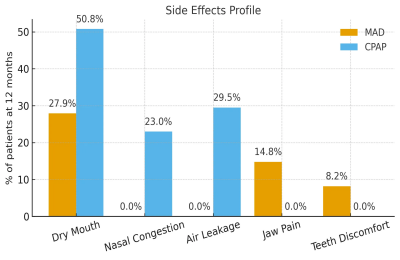
Common OAT side effects include morning jaw soreness (usually self-limiting), hypersalivation or xerostomia (often transient), tooth tenderness (typically resolves within weeks), and occlusal changes (cumulative and irreversible). The most clinically significant late side effect is posterior open bite from mandibular advancement; the literature reports incidence between 8 and 25 percent over five years. Catching it early with a morning AM aligner protocol prevents most progression.
Key Takeaways
- Follow-up cadence: 1 week, 1 month, 3 months, 6 months, then annually per AADSM guidance.
- The 3-month titrated HSAT is the cornerstone of efficacy documentation and E0486 medical necessity.
- Assess subjective symptoms, ESS, device condition, and occlusion at every visit.
- Document protrusive position in millimeters at every titration adjustment.
- Telemedicine codes 99421-99423 and 99441-99443 support interim check-ins between visits.
Frequently Asked Questions
Q: Is the three-month titrated HSAT mandatory for Medicare?
A: CMS LCDs vary by MAC, but most require objective documentation of efficacy. The AADSM strongly recommends a titrated HSAT regardless of payer requirements.
Q: What if a patient refuses the three-month sleep test?
A: Document the refusal, the discussion of risks, and rely on subjective ESS improvement plus bed-partner report. Note that some payers may deny continued coverage without objective data.
Q: How often should the device be replaced?
A: Most labs warranty MADs for 2 to 3 years, and HCPCS E0486 supports replacement every 5 years under Medicare with documented medical necessity and continued use.
Q: What ESS score indicates successful therapy?
A: An ESS below 10 with resolution of witnessed apneas and snoring is generally considered a successful subjective outcome.
Q: Can hygiene appointments count as annual OAT recalls?
A: Only if the OAT-specific assessment (ESS, device exam, occlusal evaluation, symptom review) is documented separately by the treating dentist.
Final Thoughts
A disciplined follow-up schedule protects the patient, the practice, and the reimbursement claim. The five-visit cadence recommended by AADSM is not arbitrary; each milestone catches a different category of problem, from acute fit issues at one week to long-term occlusal drift at the annual recall. Build the schedule into the practice management system at delivery and confirm reminders go out automatically. Patients who complete the full follow-up sequence have markedly better long-term adherence and far fewer late complications.

Need help ?
Schedule your initial consultation today and start your journey towards a pain-free, healthier smile. Contact us now!
Blog Suggestions
How do you bill medical insurance for a sleep apnea oral appliance?
Billing medical insurance for a sleep apnea oral appliance starts with HCPCS E0486 supported by an LMN, the qualifying sleep study, a prescription, and a face-to-face encounter.
Which ICD-10 and CPT codes apply to sleep apnea oral appliance therapy?
OAT uses G47.33 for OSA, R06.83 for snoring, HCPCS E0486 for the custom titratable device, and CPT 95800 to 95811 for diagnostic sleep studies.
What does Medicare require to cover an oral appliance for OSA?
Medicare covers E0486 when the patient has a qualifying sleep study (AHI ≥15, or 5-14 with comorbidities), a face-to-face encounter, a custom titratable device, and an enrolled DME supplier.
How do dental practices stay HIPAA-compliant when handling sleep study data?
Treat every PSG and HSAT report as PHI: sign BAAs with sleep physicians and labs, encrypt data at rest and in transit, restrict access by role, and maintain audit logs.