
Sleep Apnea Mouth Guards: Do They Work, and Is Custom Worth It?
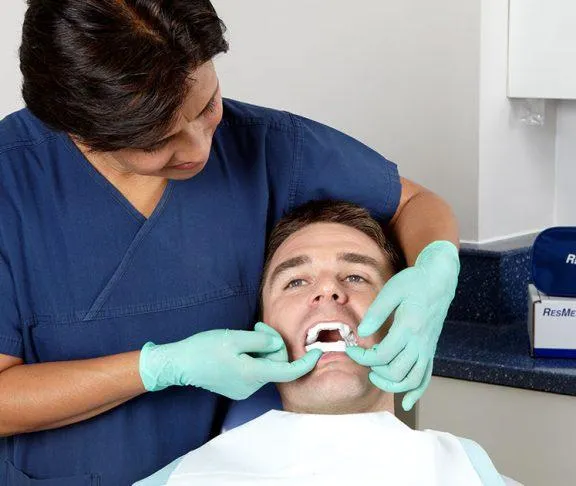
A sleep apnea mouth guard works by holding the lower jaw slightly forward so the tongue and soft tissue cannot collapse into the airway. Custom, adjustable devices made by a dentist are a guideline-supported treatment for obstructive sleep apnea. Over-the-counter boil-and-bite guards are built for snoring, are not fitted to your bite, and are not a substitute for a diagnosed patient.
What Is a Sleep Apnea Mouth Guard?
The clinical name is a mandibular advancement device, often shortened to MAD, and the treatment is called oral appliance therapy. The device fits over the upper and lower teeth like two thin retainers connected by a mechanism that positions the lower jaw a few millimeters forward of its resting position. Moving the jaw forward pulls the base of the tongue with it and tightens the soft tissue at the back of the throat, which keeps the airway open during sleep.
It is not the same thing as a night guard for teeth grinding. A grinding guard is a flat protective layer between the teeth and does nothing to advance the jaw. Wearing one does not treat sleep apnea, and small studies have suggested that in some patients a flat upper splint can make breathing events slightly worse. If you grind your teeth and also snore or wake unrefreshed, tell your dentist both things.
Your oral health is more important than you might realize. It's not just about having a bright smile, it's about maintaining your overall well-being. Regular dental check-ups, proper brushing and flossing, and a healthy diet can prevent many dental issues.
Do Mouth Guards Actually Work for Sleep Apnea?
Yes, for the right patient. The American Academy of Sleep Medicine and the American Academy of Dental Sleep Medicine published a joint clinical practice guideline in 2015 that recommends oral appliance therapy for adults with obstructive sleep apnea who cannot tolerate CPAP or who prefer an alternative. The same guideline suggests a custom, titratable appliance over a non-custom one.
What the research consistently shows:
- Oral appliances reduce the apnea-hypopnea index, snoring, and daytime sleepiness in most patients with mild to moderate obstructive sleep apnea.
- CPAP lowers the apnea-hypopnea index more on the nights it is worn, but patients wear oral appliances for more hours and more nights. In head-to-head trials the real-world health outcomes are often similar.
- Response is individual. Some patients reach a normal breathing index, some improve partially, and a minority do not respond at any comfortable jaw position.
- A follow-up sleep test with the appliance in place is the only way to confirm the device is working. Feeling better is encouraging but it is not proof.
Custom vs Over-the-Counter: What Is the Real Difference?
The price gap is large, so it is worth being specific about what you are paying for.
- Fit. A custom device is fabricated from a digital scan or impression of your teeth. A boil-and-bite guard is softened in hot water and molded at home, which produces a looser, bulkier fit that tends to fall out or press unevenly on teeth.
- Adjustment. A custom device advances in small, measured increments, often a fraction of a millimeter at a time, so the dentist can find the position that opens your airway without overloading the jaw joint. Most over-the-counter guards have one or two fixed positions.
- Regulatory status. Most over-the-counter devices are marketed for snoring. Custom appliances used for treatment carry FDA clearance for obstructive sleep apnea and are dispensed after a diagnosis.
- Durability. Custom appliances are made from hard acrylic or milled and printed polymers and commonly last several years. Thermoplastic guards deform and usually need replacing within months.
- Supervision. With a custom device, a dentist checks your jaw joints and bite over time and a physician confirms the result with a sleep test. With a store-bought guard, nobody is checking whether your breathing actually improved.
The practical risk with an over-the-counter guard is not that it does nothing. It is that it quiets the snoring, which removes the warning sign, while leaving the apnea partly or wholly untreated.
How Much Does a Sleep Apnea Mouth Guard Cost?
Over-the-counter snoring guards typically cost between 50 and 200 dollars. A custom oral appliance generally costs between 1,500 and 3,500 dollars when paid entirely out of pocket, and that fee usually covers the exam, scans, the device, fitting, adjustment visits, and early follow-up.
Custom appliances for diagnosed obstructive sleep apnea are billed to medical insurance, not dental insurance, under HCPCS code E0486. Medicare and many commercial plans cover them when the diagnosis and documentation meet the plan criteria. Ask the dental office to verify your medical benefits before any scan or impression is taken, so you know your share in advance.
What Are the Side Effects?
Most side effects are mild and settle within the first few weeks:
- Jaw or tooth soreness in the morning, usually gone within an hour of removing the device.
- Extra saliva or a dry mouth during the adjustment period.
- A bite that feels different for a short time after waking. Morning jaw exercises or a small repositioning aid help the teeth settle back.
- Gradual, small changes in how the teeth meet over years of nightly use. This is expected, is usually not bothersome, and is the reason regular dental follow-up matters.
Persistent jaw joint pain, loose teeth, or a bite that does not return to normal during the day are reasons to call your dentist rather than push through.
How Do You Get a Custom Mouth Guard?
The pathway is the same in almost every practice:
- A sleep study, at home or in a lab, interpreted by a physician who makes the diagnosis.
- A prescription or referral for oral appliance therapy.
- A dental exam to confirm you have enough healthy teeth and a jaw joint that can tolerate the device.
- A digital scan of the teeth and a bite record that sets the starting jaw position.
- Delivery of the appliance, followed by gradual adjustment over several weeks.
- A follow-up sleep test with the appliance in place to confirm it is working.
A dentist cannot diagnose sleep apnea, and a physician does not make the appliance. The treatment works best when the two share records and results, which is how practices on the Appnea platform co-manage patients.
Key Takeaways
- A sleep apnea mouth guard is a mandibular advancement device that holds the lower jaw forward to keep the airway open.
- The 2015 AASM and AADSM guideline supports custom, titratable appliances for adults who cannot tolerate or do not want CPAP.
- Over-the-counter guards are made for snoring and can mask untreated apnea.
- Custom appliances cost roughly 1,500 to 3,500 dollars and are billed to medical insurance under E0486.
- A follow-up sleep test with the device in place is what confirms it works.
Frequently Asked Questions
Q: Can I use a regular night guard for sleep apnea?
A: No. A night guard protects teeth from grinding and does not move the jaw forward. It does not treat sleep apnea.
Q: Is a mouth guard as good as CPAP?
A: CPAP reduces breathing events more per night of use, but oral appliances are worn more consistently. For mild to moderate sleep apnea, outcomes are often comparable. Severe cases are usually offered CPAP first.
Q: Do I need a sleep study before getting one?
A: Yes. A physician must diagnose obstructive sleep apnea before a custom appliance is prescribed, and insurance requires the study.
Q: How long does a custom appliance last?
A: Several years with normal care. Medicare allows replacement every five years when medical need continues.
Q: Will it work if I have dentures or missing teeth?
A: It depends on how many healthy teeth remain to anchor the device. Your dentist may suggest a different design or a tongue-retaining device.
Final Thoughts
The words mouth guard cover two very different products. One is a molded piece of plastic that may reduce the noise. The other is a prescribed medical device, fitted and adjusted by a dentist, verified by a sleep test, and covered by medical insurance. If you have been diagnosed with sleep apnea, or suspect you have it, the second one is the treatment. This article is general education and not medical advice. Talk to a physician about testing and a qualified dentist about whether oral appliance therapy fits your case.

Need help ?
Schedule your initial consultation today and start your journey towards a pain-free, healthier smile. Contact us now!
Blog Suggestions
Types of Oral Appliances for Sleep Apnea and How to Choose
Mandibular advancement devices and tongue-retaining devices compared by design: push, pull, dorsal fin, anterior, and milled. Which designs meet Medicare E0486 requirements, and how to match the device to the patient.
Epworth Sleepiness Scale: How to Score It and What the Number Means
The eight Epworth questions, the 0 to 24 scoring bands, what a score of 11 or more means, what the scale cannot tell you about sleep apnea, and how to use it to document and track oral appliance therapy.
Mallampati Score and Sleep Apnea: What Classes I to IV Mean
What each Mallampati class shows, how to perform the assessment correctly, how strongly the score predicts obstructive sleep apnea, how it differs from Friedman tongue position, and where it fits in dental screening.
Scalloped Tongue: Causes, and When It Points to Sleep Apnea
Why the edges of the tongue become wavy, the common causes from clenching to hypothyroidism, what the research says about the link to obstructive sleep apnea, and what a dentist should do on seeing one.