
AI Medical Billing and Coding for Dental Sleep Claims

AI medical billing tools help a dental sleep practice in four ways: suggesting codes from the clinical record, checking claims for errors before submission, assembling prior authorization packets, and sorting denials by cause. They reduce avoidable mistakes and staff time. They cannot create medical necessity, replace the physician's documentation, or take responsibility for what is submitted. The provider remains accountable for every claim.
Why Is Medical Billing Hard for Dental Practices?
Dental teams are skilled at dental billing. Medical billing for oral appliance therapy asks them to work in a system they were never trained in.
- Three code sets apply. ICD-10 for the diagnosis, HCPCS and CPT for the device and services, and CDT for the dental side.
Your oral health is more important than you might realize. It's not just about having a bright smile, it's about maintaining your overall well-being. Regular dental check-ups, proper brushing and flossing, and a healthy diet can prevent many dental issues.

- Coverage is conditional. Payment depends on the sleep study result, symptoms, CPAP history, and device specifications all being documented.
- Each payer differs. Authorization rules, modifiers, and place of service requirements vary from plan to plan.
- Volume is low. A practice delivering a few appliances a month never builds the repetition that makes a full-time medical biller fluent.
Low volume combined with high complexity is exactly the situation in which people make errors and software helps.
What Can AI Do in Medical Coding and Billing?
The useful applications are narrow and practical.
- Code suggestion. Reading the documented diagnosis and services and proposing the matching ICD-10, CPT, HCPCS, and CDT codes for a person to confirm.
- Claim checking. Reviewing a claim before submission for missing modifiers, a diagnosis that does not support the procedure, an absent authorization number, or a mismatch between the ordering physician and the record.
- Documentation completeness. Flagging when the file lacks a numeric apnea-hypopnea index, a signed order, or a documented CPAP history before the claim is built.
- Prior authorization assembly. Gathering the sleep study, clinical notes, and order into a request, and drafting the letter of medical necessity for the physician to review and sign.
- Eligibility interpretation. Summarizing a payer's benefit response in plain terms and highlighting whether authorization is needed.
- Denial sorting. Reading remittance codes and grouping denials by cause, so the practice can see that most of its denials trace to one fixable step.
- Appeal drafting. Preparing a first draft of an appeal that maps each cited deficiency to the document that answers it.
What Can AI Not Do?
Understanding the limits protects the practice.
- It cannot establish medical necessity. That comes from the physician's evaluation and the sleep study. Software can only report what is in the record.
- It cannot supply missing documentation. If CPAP intolerance was never documented, no tool can legitimately add it.
- It cannot know every payer's current policy. Policies change, and a suggestion based on a general rule may be wrong for a particular plan.
- It cannot accept liability. A claim submitted with an incorrect code is the provider's claim, whoever or whatever suggested the code.
- It cannot replace judgment on unusual cases. Secondary coverage, workers' compensation, and atypical diagnoses need a person.
What Are the Compliance Risks?
Two risks deserve particular attention.
- Inaccurate claims. A tool tuned to maximize reimbursement may suggest codes or modifiers the documentation does not support. Submitting them can violate payer rules and, for federal programs, the False Claims Act. Any suggestion that increases payment should be checked against the record before it is accepted.
- Privacy. Billing data is protected health information. A vendor that processes it needs a business associate agreement, encryption, access controls, and a clear statement of whether patient data is used to train models.
The safeguard for both is the same. Keep a person in the loop, and keep a log. Every suggestion accepted, every claim submitted, and every change made should be traceable to a user and a time.
How Do You Evaluate an AI Billing Tool?
Ask questions that reveal how the tool behaves when it is wrong.
- Does it show why it suggested a code, with reference to the documentation?
- Can a user override it, and is the override recorded?
- Does it check claims against payer-specific rules or only general ones?
- How often are its code libraries and rules updated?
- Does it work within the clinical record, or does data have to be exported to it?
- Will the vendor sign a business associate agreement covering the AI functions?
- What reporting does it provide on denials and their causes?
A tool that cannot explain its suggestions is asking for trust it has not earned.
What Results Should You Expect?
The realistic gains are in error reduction and time, not in higher payment per claim.
- A higher first-pass acceptance rate, because common omissions are caught before submission.
- Fewer denials for missing or inconsistent documentation.
- Shorter time from delivery to claim submission.
- Less staff time spent on hold with payers and on retyping.
- Better visibility into why denials happen.
Measure these before adopting a tool and again three months after. If first-pass acceptance and days to submission have not improved, the tool is not earning its place.
How Does Appnea Use AI in Billing?
Appnea applies AI at several points in its revenue cycle tools. Claims are prepared with AI-assisted coding suggestions, supported by built-in ICD, CPT, and CDT libraries for both medical and dental billing. Real-time eligibility checks confirm coverage before treatment, with alerts for gaps or policy issues, and preauthorization is built into treatment planning. The AI Assistant can check whether a plan covers oral appliance therapy, begin a prior authorization request with clinical notes attached, and generate claims from the record on a typed or spoken request. It also validates entries in records, scheduling, and billing as they are made. Every action in the billing system is time-stamped in an audit trail.
The design principle is that data is entered once and carried forward, with AI checking it along the way and a person reviewing the result before it is submitted. At Appnea that person is not the doctor. Appnea's Insurance and RCM team prepares and submits the claim, which means the practice gets the benefit of AI-assisted billing without having to staff a medical billing desk.
Key Takeaways
- AI helps with code suggestion, claim checking, authorization assembly, and denial analysis.
- It cannot create medical necessity or documentation that does not exist.
- The provider is accountable for every claim, regardless of what suggested the codes.
- Require explanations, overrides, audit logs, and a business associate agreement from any vendor.
- Judge the tool by first-pass acceptance, denial rate, and time to submission.
Frequently Asked Questions
Q: Do we need to hire a medical biller to use AI billing tools with Appnea?
A: No. At Appnea we handle that for you. Our Insurance and RCM team prepares and submits the claims, using the platform's AI-assisted coding and checks, so the practice does not need its own medical biller.
Q: What is AI medical billing?
A: The use of artificial intelligence to assist with coding, claim review, authorization, and denial management in medical billing.
Q: Can AI code a claim without human review?
A: It can propose codes, but a person should confirm them against the documentation before submission.
Q: Will AI increase reimbursement?
A: Its main effect is fewer errors and faster submission. It should not be used to bill more than the documentation supports.
Q: Is AI billing software HIPAA compliant?
A: It depends on the vendor. Confirm the business associate agreement, encryption, and how patient data is used.
Q: Does AI help with prior authorization?
A: Yes. It can gather the required documents and draft the request, which shortens preparation time. The physician still signs.
Final Thoughts
The honest case for AI in dental sleep billing is modest and strong. It is not that software understands payers better than an experienced biller. It is that most dental practices do not have an experienced medical biller, and most denials come from simple omissions that software is good at catching. Used as a careful checker with a person making the final call, AI brings a low-volume practice much closer to the accuracy of a specialist billing team.

Need help ?
Schedule your initial consultation today and start your journey towards a pain-free, healthier smile. Contact us now!
Blog Suggestions
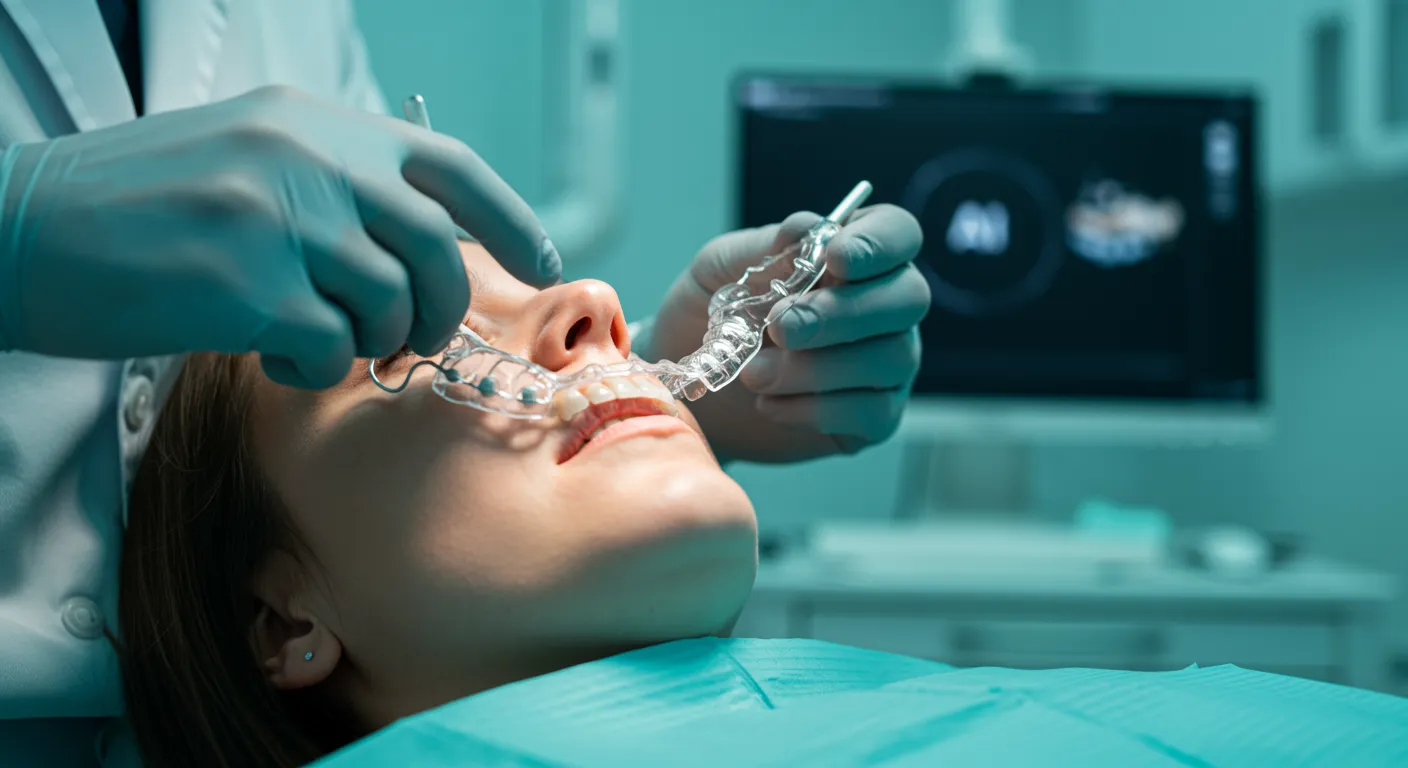
Bite Registration for Oral Appliances: From the George Gauge to MAD-FIT
How the conventional George Gauge bite registration works, why a percentage of protrusive range is a rule of thumb, why vertical and lateral dimensions matter, and how MAD-FIT calculates a patient-specific jaw position.
Oral Appliance Efficacy – Time for Augmented Intelligence!
Machine learning and artificial intelligence are actually making the financial trades. Dr. Singh points to a simple reason: Machines can analyze meta data from all kinds of news sources, as soon as it is made public and comes across digital channels.

The Mystery of Sleep Disorders: What You Need to Know
In today’s busy world, restful sleep is more vital than ever—yet for many people, a full night of quality rest feels out of reach.

The Silent Connection: Nasal Obstruction and Obstructive Sleep Apnea (OSA)
Nasal obstruction occurs when the nasal passages become narrowed or blocked, limiting airflow.