
Bite Registration for Oral Appliances: From the George Gauge to MAD-FIT
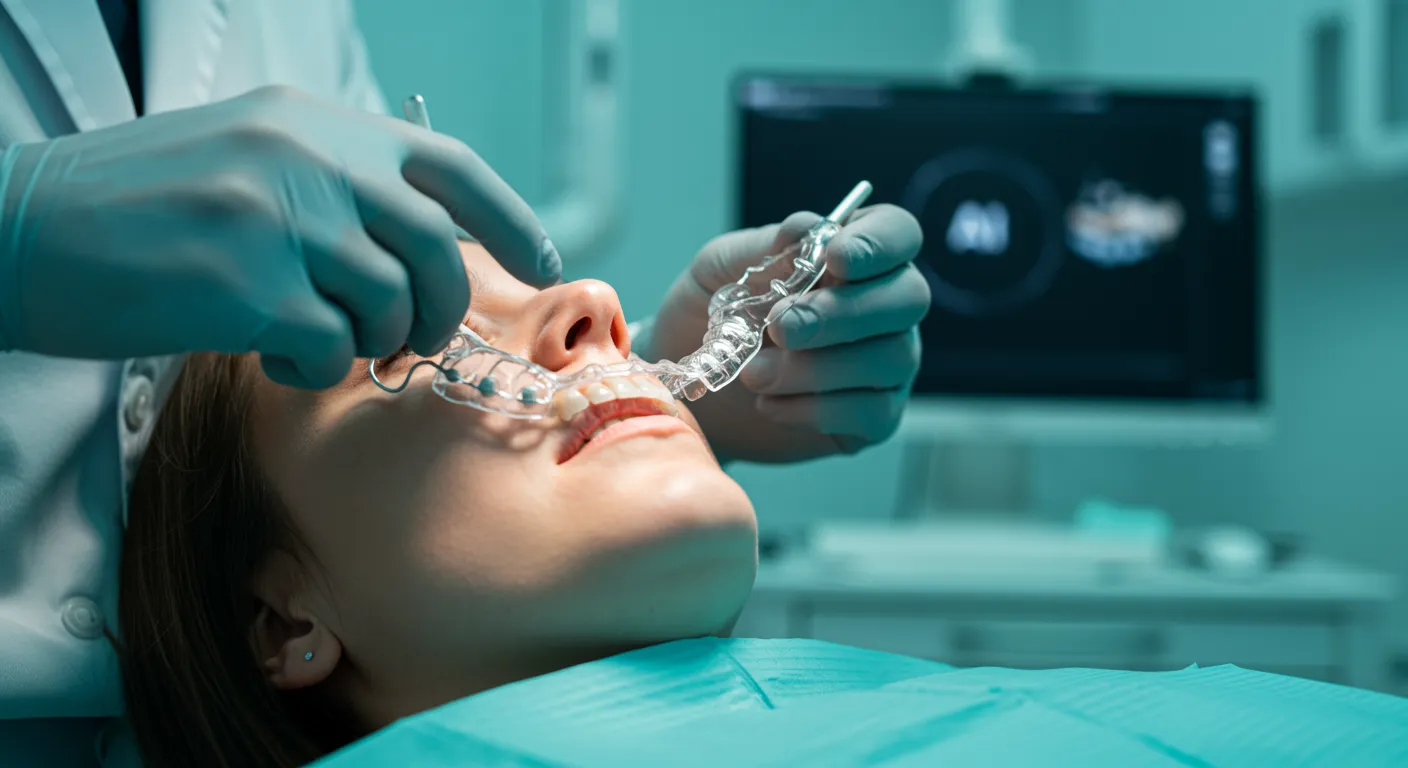
The bite registration for an oral appliance records the forward jaw position the device will hold during sleep. Conventionally the dentist measures the patient's protrusive range with a gauge, sets a starting point at a fraction of that range, and advances over weeks until symptoms improve. MAD-FIT, Appnea's patient-specific algorithm, uses clinical data to calculate a therapeutic position that includes vertical and lateral dimensions, with the aim of effective treatment from the first night.
What Is a Bite Registration for an Oral Appliance?
In restorative dentistry, a bite registration records how the teeth meet. For oral appliance therapy it records something different: a deliberately altered jaw position, forward of normal, in which the lab will build the device. The registration tells the lab where the lower arch should sit relative to the upper when the appliance is worn.
That position determines how far the tongue base and soft tissue are moved away from the back of the throat. Too little advancement and the airway still collapses. Too much and the jaw joints, muscles, and teeth are overloaded, and the patient stops wearing the device. The registration is therefore the most consequential record in the case.
Your oral health is more important than you might realize. It's not just about having a bright smile, it's about maintaining your overall well-being. Regular dental check-ups, proper brushing and flossing, and a healthy diet can prevent many dental issues.


How Is the Conventional Bite Registration Taken?
The most familiar instrument is the George Gauge, and the steps are broadly the same in most practices.
- Select a bite fork. Forks come in different thicknesses, commonly two and five millimeters, which set the vertical opening between the incisors.
- Measure the range. The patient slides the lower jaw as far back as it will go, then as far forward as it will go, and the gauge reads both positions on a millimeter scale.
- Choose the starting position. The dentist sets the gauge at a percentage of the total range. Practices commonly start between 50 and 70 percent of maximum protrusion.
- Check the midline. The jaw should advance straight, without an unintended shift to one side.
- Record the position. Registration material is applied to the fork, or the position is captured with an intraoral scanner, and sent to the lab with the models.
Other gauges and jig systems exist, and some clinicians use speech-based or swallowing-based methods to find the position. All of them produce a starting point that is then adjusted.
What Are the Limits of the Conventional Approach?
The method is practical and widely taught, and it has three known weaknesses.
- The starting point is a rule of thumb. A fixed percentage of protrusive range treats every airway as if it responded the same way. Patients differ in where obstruction occurs and how much advancement relieves it.
- It is largely one-dimensional. The gauge measures forward movement at a vertical opening fixed by the fork. The amount of mouth opening and any lateral component are set by convention, not calculated for the patient.
- The endpoint is found by trial and error. The appliance is advanced step by step, guided by the patient's report of snoring and sleepiness, until symptoms resolve or the jaw will not tolerate more. This serial titration takes weeks to months, consumes several appointments, and leaves the patient undertreated in the meantime.
Subjective improvement is also an imperfect guide. Patients often feel better before their breathing is controlled, which is why an objective sleep test with the appliance in place is needed at the end.
Why Do Vertical and Lateral Dimensions Matter?
Forward movement receives the most attention, but the jaw moves in three dimensions and the airway responds to all of them.
- Vertical opening. Opening the mouth rotates the lower jaw down and back, which can narrow the airway behind the tongue. A small amount of opening is needed to fit the appliance, and more than necessary can work against the advancement.
- Lateral position. A jaw held slightly off its natural path loads one joint more than the other, which affects comfort and whether the patient keeps wearing the device.
- Individual anatomy. Tongue size, palate shape, and neck dimensions change how much each millimeter of movement achieves.
In the large clinical study that preceded MAD-FIT, which followed 390 patients treated with serially titrated appliances, Appnea reports that the degree of mouth opening induced by the appliance had an impact on treatment outcome. That observation is part of the reason vertical dimension is treated as a variable to be set, not a byproduct of fork thickness.
How Does MAD-FIT Approach the Problem?
MAD-FIT was developed by Dr. Pankaj Singh, the founder of Appnea, from more than a decade of clinical research. It is a multi-variable, patient-specific algorithm that uses machine learning to calculate the therapeutic position of the mandible for oral appliance therapy. Instead of starting at a percentage and searching forward, the aim is to identify the intended end position at the outset, in three dimensions.
According to Appnea, a follow-up multicenter study of the algorithm included 125 patients who met the same criteria as the original study. The company reports these results:
- 115 patients used the appliance four or more nights per week.
- 103 patients reported successful treatment from the first night of wear.
- 21 patients required further titration, ranging from 1.8 millimeters back to 2.4 millimeters forward.
These figures are reported by Appnea from its own research and describe a working paper. They should be read as the company's evidence for its method and weighed accordingly.
What Does AI Not Replace?
A calculated position is a better-informed starting point. It does not remove the clinical steps around it.
- The examination. Teeth, periodontal support, and jaw joints must be assessed in person before any appliance is made.
- Tolerance. If a patient cannot comfortably hold the suggested position, clinical judgment governs. The dentist backs off and adjusts.
- Objective verification. A sleep test with the appliance in place, interpreted by the physician, is still the standard for confirming that treatment works.
- Follow-up. Side effects and bite changes need monitoring over the long term however the position was chosen.
- Non-responders. Some patients will not be adequately treated with an appliance at any tolerable position. Identifying them earlier is a benefit of better prediction, not a cure for the problem.
What Does This Mean for Practice Workflow?
The operational effect of a more accurate first position is fewer visits.
- Fewer titration appointments per case, which frees chair time.
- A shorter interval between delivery and effective treatment.
- An earlier efficacy test, and an earlier report back to the referring physician.
- A clearer record, because the intended position and the reasoning are documented at the start.
Practices can test this for themselves by tracking titration visits per delivered case and days from delivery to confirmed efficacy.
Key Takeaways
- The bite registration sets the jaw position the appliance will hold and is the most consequential record in the case.
- The conventional method measures protrusive range, starts at a percentage of it, and titrates by trial and error.
- Vertical opening and lateral position affect both airway response and comfort.
- MAD-FIT uses patient data to calculate a three-dimensional therapeutic position at the outset.
- Examination, tolerance, objective sleep testing, and follow-up remain necessary.
Frequently Asked Questions
Q: What is a George Gauge?
A: An instrument that measures how far a patient can move the lower jaw backward and forward, and records a chosen position for the lab.
Q: What starting position is typically used?
A: Many clinicians begin between 50 and 70 percent of the patient's maximum protrusion and adjust from there.
Q: What is titration?
A: The gradual adjustment of the appliance, usually forward, to find the position that controls breathing events comfortably.
Q: Does MAD-FIT eliminate the follow-up sleep test?
A: No. An objective test with the appliance in place is still needed to confirm the result.
Q: Can the bite be recorded digitally?
A: Yes. An intraoral scanner can capture the arches in the protrusive position, producing files the lab can use directly.
Final Thoughts
For most of the history of oral appliance therapy, the jaw position has been found by starting somewhere reasonable and moving until the patient felt better. That works, slowly. The case for calculating the position from patient data is that the information needed to make a better first choice already exists in the record. Used with clinical judgment and verified with a sleep test, a better first position means fewer visits and earlier relief for the patient.

Need help ?
Schedule your initial consultation today and start your journey towards a pain-free, healthier smile. Contact us now!
Blog Suggestions
Oral Appliance Efficacy – Time for Augmented Intelligence!
Machine learning and artificial intelligence are actually making the financial trades. Dr. Singh points to a simple reason: Machines can analyze meta data from all kinds of news sources, as soon as it is made public and comes across digital channels.

The Mystery of Sleep Disorders: What You Need to Know
In today’s busy world, restful sleep is more vital than ever—yet for many people, a full night of quality rest feels out of reach.

The Silent Connection: Nasal Obstruction and Obstructive Sleep Apnea (OSA)
Nasal obstruction occurs when the nasal passages become narrowed or blocked, limiting airflow.

How Menopause and Snoring Are Connected: What Every Woman Should Know
Snoring isn’t just something that disturbs your partner — for many women, it’s an unexpected symptom of midlife changes, particularly menopause.